In construction, manufacturing, and industrial workplaces, a safety helmet — commonly referred to as a hard hat — is more than just protective gear. Its colour coding serves as a critical visual communication tool, allowing supervisors, safety officers, and emergency personnel to identify roles, responsibilities, and authority levels at a glance. In high-risk environments, this system enhances site safety, coordination, and emergency response efficiency.
________________________________________
Why Safety Helmet Colour Coding Matters
Implementing a helmet colour code system on-site provides several advantages:
• Clear visual identification of personnel – distinguishing engineers, supervisors, workers, and visitors.
• Improved communication and coordination – reducing confusion in complex or crowded sites.
• Enhanced emergency response – quickly locating fire wardens, first aiders, or safety officers.
• Professional and safety image – projecting organized and compliant safety management to clients and regulators.
In essence, helmet colours act as a non-verbal communication system, streamlining workflow and promoting safety culture on Sri Lankan construction and industrial sites.
________________________________________
Safety Helmet Standards in Sri Lanka
It’s important to understand that in Sri Lanka, helmet colour codes are not defined by any SLS (Sri Lanka Standards) or BS (British Standards) regulation. Instead, colour selection is influenced by: international practice, company policy, and site management needs.
1. Influence from British Standards-Based Systems
Sri Lankan construction safety practices were historically influenced by British regulations. Many companies still use BS EN 397-compliant industrial safety helmets, and they often adopt UK-style colour coding.
However, this imitation is not an official requirement.
What the standards actually cover:
• BS EN 397 and SLS 1414 define helmet performance parameters, including:
o Impact absorption
o Penetration resistance
o Chin strap strength
o Electrical insulation
o Flame resistance
• These standards do not prescribe colours for site roles, nor do they define job-specific identification.
________________________________________
2. Adoption from Multinational and ISO-Certified Contractors
Large local and international contractors, such as Maga, Access Engineering, L&T, and projects managed by international consultants, often adopt internal helmet colour policies. These are typically aligned with:
• BuildUK (UK guidelines)
• OSHA/ANSI (US standards)
• ISO 45001 occupational safety management systems
These companies often influence smaller subcontractors, who follow these colour conventions to ensure site compliance.
________________________________________
3. Practical Site Management
Colour coding also serves practical site supervision purposes. Sri Lankan sites often adopt colour schemes to allow instant visual identification of personnel:
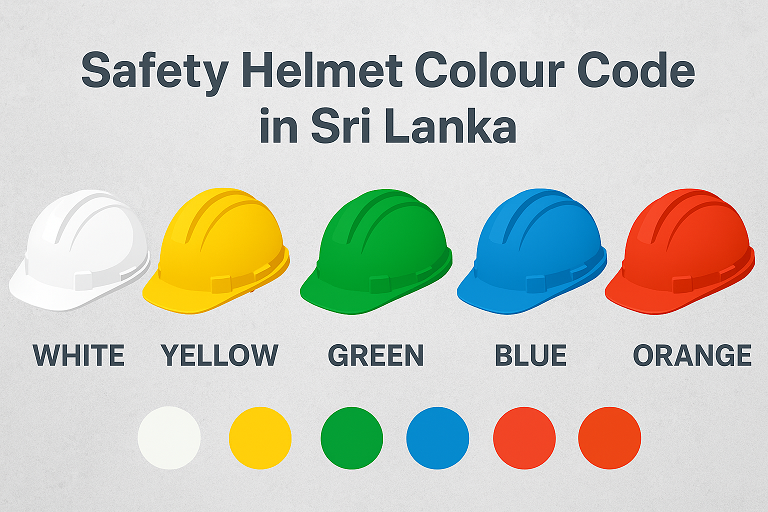
Helmet Colour Typical Role / Function
White Site Engineers, Managers
Yellow Skilled and General Workers
Blue Technical Staff, Operators, Electricians, Security Personnel
Green Safety Officers, First Aiders
Red Fire Wardens or Emergency Personnel
Orange Variable – no uniform trend observed
The main goal is quick identification in high-risk or congested environments, allowing supervisors to respond faster to hazards or emergencies.
________________________________________
4. Market Availability Trends
Local helmet manufacturers in Sri Lanka typically produce helmets in white, yellow, green, blue, red, and orange, with white, yellow, blue, and green being the most commonly stocked colours. This availability directly influences smaller contractors and minor construction sites, who select colours based on what is easily sourced.
________________________________________
5. Government and Project-Specific Requirements
Some state projects in Sri Lanka, including those by the Ceylon Electricity Board (CEB), Road Development Authority (RDA), and Water Board, may request contractors to supply helmets in specific colours.
• Unlike general industry practice, these projects do not always mandate role-specific assignments; often they only specify which colours must be provided.
• CEB, however, has detailed specifications in its document:
“SPECIFICATIONS FOR PERSONAL PROTECTIVE EQUIPMENT – HEAD PROTECTION – INDUSTRIAL SAFETY HELMET.”
This document assigns colours to different categories of personnel to ensure clarity and uniformity on-site:
Helmet Colour Assigned Personnel
White Engineers, Superintendents, Technical Assistants
Blue Field Staff Grade 2 and higher
Yellow Field Staff, Trainees, CRO staff, Outsourced Workers
Red Firefighters
Grey Visitors
Following these specifications helps maintain safety discipline, role identification, and emergency preparedness.
________________________________________
Choosing, Maintaining, and Replacing Helmets
Regardless of colour, what matters most is helmet performance and maintenance:
• Use SLS 1414- or BS EN 397-certified helmets to ensure compliance with impact and penetration requirements.
• Inspect regularly for cracks, fading, or damage to the shell or suspension system.
• Replace helmets after 2–3 years of use, or immediately if damaged.
• Avoid painting or altering the helmet, as this may compromise material integrity.
________________________________________
Conclusion
In Sri Lanka, safety helmet colour coding is not regulated by a national standard, but commonly follows international conventions and project-specific requirements for role identification. While the assignment of colours is flexible, it is essential to display colour code roles clearly on-site. Ultimately, the priority is certified, well-maintained, and correctly replaced helmets to ensure maximum worker protection.
- Anushan Sundararaj, MEng
Magnum Industrial Safety
Safety Helmet Colour Code in Sri Lanka: Meaning, Standards, and Site Practices Explained
October 22, 2025
Publisher:
Featured Blogs

Do You Actually Need a Safety Jacket? The Surprising Benefits of a Simple Cross Belt.
Nov 22, 2025
Safety Helmet Colour Code in Sri Lanka: Meaning, Standards, and Site Practices Explained
Oct 22, 2025
Magnum Industrial Safety Is Now Live on Daraz Sri Lanka!
Oct 13, 2025